PTFE, famously referred to as Teflon, was not an intended exploration. In 1938, DuPont stumbled upon this remarkable compound quite by crash, triggering a revolution in materials scientific research and commercial applications.
One early morning in 1938, Roy Plunkett, a young drug store, was active playing with his experiments behind-the-scenes of DuPont. His task appeared easy: discover a brand-new cooling agent.

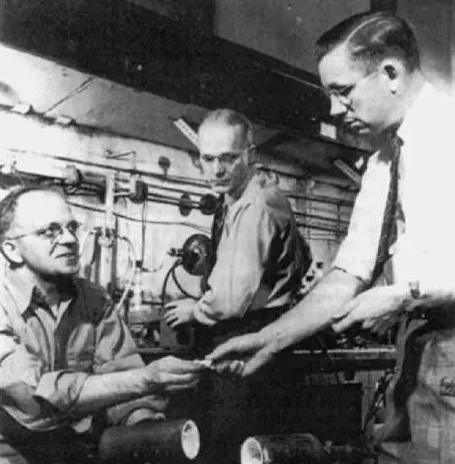
(Roy and his colleagues)
Nevertheless, just when Roy thought it was simply a regular job, things deviated. He saved the tetrafluoroethylene gas in a cyndrical tube and stated to himself: “Okay, see you tomorrow.” The following day, when he returned to continue his experiment, he located that the gas had actually strangely vanished, leaving just a heap of white powder. Well, this was definitely various from the manuscript he intended. Envision his expression back then: half baffled, half curious. Upon more examination, he uncovered that this odd white powder had some cool superpowers: it was hostile to almost all chemicals, could stay amazing at extreme temperatures, and was as slippery as oil. Unexpectedly, Luo realized that while he had yet to locate a brand-new refrigerant, he had inadvertently discovered the secret ingredient of the kitchen area superhero of the future – non-stick frying pans. From then on, frying eggs was no more a difficulty, and cleansing pots became a breeze.
Although the exploration of PTFE was unintentional, it had big advanced importance for the plastics industry and many various other fields, such as aerospace, automobiles, electronics, and devices. PTFE is extensively made use of as a result of its one-of-a-kind chemical and physical properties – extremely reduced rubbing coefficient, high-temperature resistance, chemical security, and non-stickiness. From kitchen area tools to vital parts of the space capsule, PTFE made numerous cutting-edge applications possible. However while PTFE (Teflon ®) noted a revolutionary breakthrough in materials science, it was only the beginning of a long and challenging roadway to commercialization and extensive application. The first difficulty was not just to find a new material but likewise to determine just how to attain massive production and just how to use it in various areas.
The processes of monomer synthesis and controlled polymerization of PTFE were not completely created, making it difficult to produce PTFE in big amounts or a viable way. While the material’s special properties were beneficial ultimately application, they additionally postured substantial obstacles during the manufacturing process. Unlike other common plastics, PTFE is not soluble in solvents, acids, or bases and does not merge a flowable liquid. Instead, when warmed, it becomes a hard, clear gel that does not melt and moves like plastics.
(Roy’s Notes: Discovery of PTFE)
To overcome these challenges, researchers and designers battled to locate procedures from various other areas, such as adapting strategies from steel and ceramic handling. To form PTFE, a procedure called paste extrusion was utilized, which was obtained from ceramic handling. Although traditional molding and creating methods had some trouble processing PTFE, it was feasible to develop PTFE parts. By 1947, considerable research and experimentation had borne fruit, and a small-scale production facility was established in Arlington, New Jersey. This marked the start of Teflon ®’s journey from the lab to the marketplace. In 1950, DuPont opened up a new plant in Parkersburg, West Virginia, considerably broadening the industrial manufacturing of Teflon ®. That very same year, the modern technology crossed the Atlantic when Imperial Chemical Industries developed the first PTFE plant outside the United States in the UK.
Provider of PTFE Powder
TRUNNANO is a supplier of 3D Printing Materials with over 12 years experience in nano-building energy conservation and nanotechnology development. It accepts payment via Credit Card, T/T, West Union and Paypal. Trunnano will ship the goods to customers overseas through FedEx, DHL, by air, or by sea. If you want to know more about hydroxypropyl methylcellulose capsules, please feel free to contact us and send an inquiry.
Inquiry us
Related Posts

The Indestructible Vessel: The Alumina Ceramic Crucible Legacy alpha alumina
Intro: The Crucible of Production In the realm of materials science, where the alchemy of warmth transforms base components into the building...
Read out all
The Elemental Bond: The Molybdenum Disulfide Revolution molybdenum disulfide powder
Intro: The Smooth Frontier In the high-stakes movie theater of modern industry, where metal grinds against metal and warm intimidates to take...
Read out all
The Molecular Revolution: Redefining Performance with Advanced Plasticiser admixture waterproofing
Intro: The Scientific Research of Circulation In the substantial and requiring landscape of modern-day construction, where structural stability meets building aspiration, there...
Read out all
The Molecular Revolution: Redefining Performance with Advanced Plasticiser admixture waterproofing
Introduction: The Science of Flow In the large and demanding landscape of modern-day building, where architectural honesty fulfills building aspiration, there exists...
Read out all
Why Boron Nitride Ceramic Is Ideal for Crucibles in Strontium Barium Niobate Crystal Growth
Boron nitride ceramic has become the top choice for crucibles used in growing strontium barium niobate crystals. This material stands out because...
Read out all
What Are the Boron Nitride Ceramic Applications in High Temperature Globe Control Valves
Boron nitride ceramic is now being used in high temperature globe control valves. This material brings strong performance where heat and pressure...
Read out all